ANTHONY CARO "CATALAN TAP DANCE" SCULPTURE, 1987
Anthony Caro (1924-2013) was an influential and innovative British sculptor. Caro played a pivotal role in the development of twentieth-century sculpture introducing abstraction through assemblages of metal using industrial and discarded components.
Caro studied engineering in London before training as a sculptor. He worked as an assistant to Henry Moore from 1951-53. Caro is credited with numerous stylistic innovations such as placing his pieces directly on the ground. His first solo show at the Whitechapel Gallery, London, in 1963, amplified his artistic voice, liberating ideas of what sculpture was and could be.
After travelling to the United States and meeting vanguard American artists--notably David Smith who worked with welded steel--Caro moved away from cast bronze and started working with steel beams, rods, plates, and tubes. He welded these objects into non-narrative compositions, later painting his works in flat, bold hues.
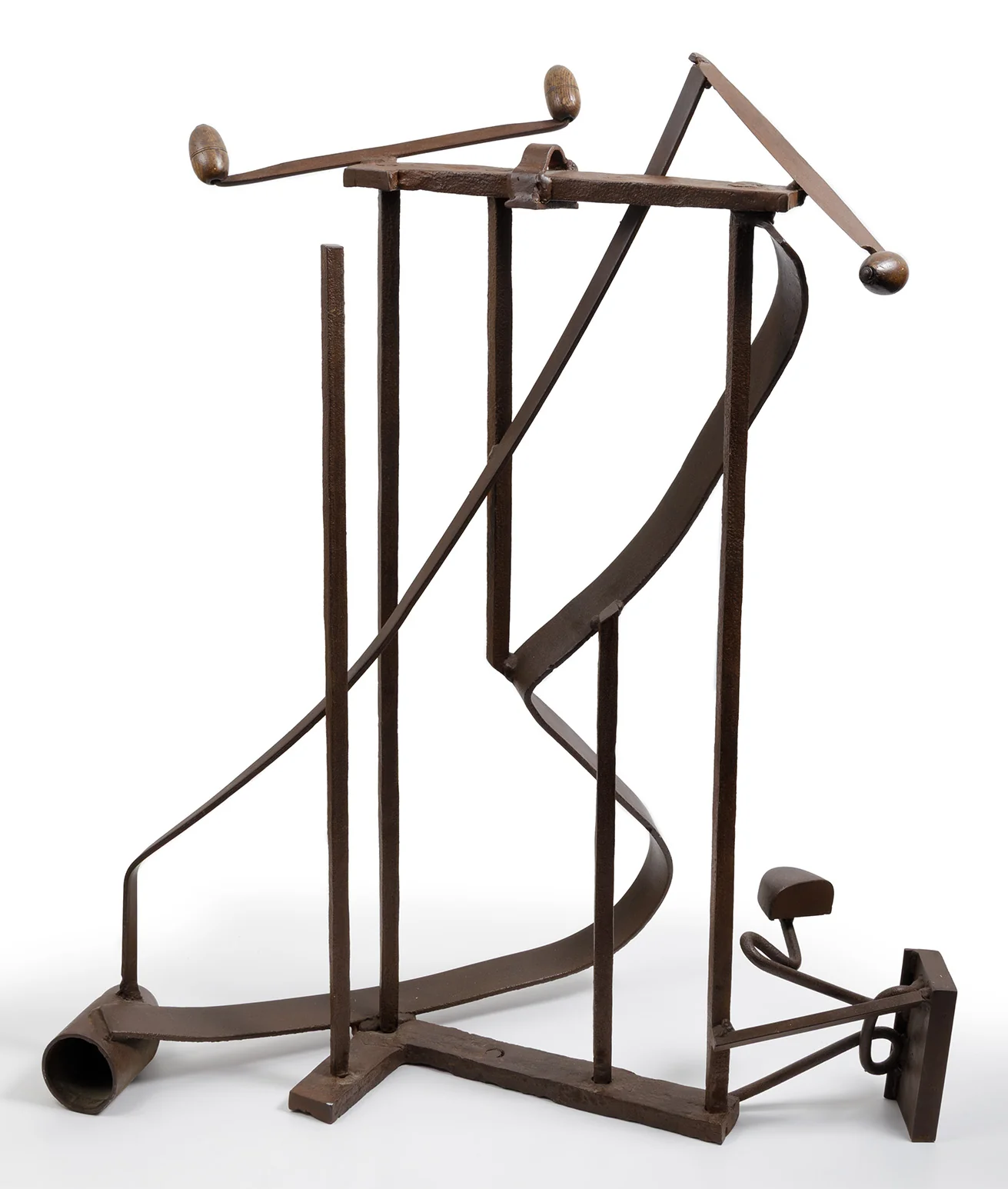
This energetic sculpture is part of Caro's Catalan series. Using steel elements from his workshop in Barcelona, he created a series of 33 table sculptures. Based on various aspects of Catalan culture, the pieces evoke the graceful, airy atmosphere of Gaudí and Catalan Art Nouveau. A selection of these were exhibited at the Sala de Exposiciones del Banco Bilbao Vizcaya, Barcelona, in 1989.
Rhythmically articulated, "Catalan Tap Dance" is a balanced expression of elegant energy. With strong vertical anchors, sweeping beams, and wooden nodules on its extremities, the sculpture leads our gaze through the sequence of its dance. Coming to life from different angles, the sculpture is imbued with lyricism and freed from spatial constraints. It embodies the metalwork design and vibrant culture of Barcelona.
Anthony Caro has had retrospectives at the MoMA, New York; the MCA, Tokyo; Tate Britain, London; among others. Major institutions across the globe hold his work in their permanent collections. He was nighted in 1987 and received the Order of Merit in May 2000.
Questions about this piece? Contact us, call +1.416.704.1720, or visit our Toronto gallery.
"Catalan Tap-dance"
1987-88
Steel and wood, rusted and waxed
43"H 37"W 20"D
Very good condition.
Literature: Dieter Blume, Anthony Caro Catalogue Raisonné Vol. VII, cat. no. 1830, illustrated pp. 26, 113.
Anthony Caro (1924-2013) was an influential and innovative British sculptor. Caro played a pivotal role in the development of twentieth-century sculpture introducing abstraction through assemblages of metal using industrial and discarded components.
Caro studied engineering in London before training as a sculptor. He worked as an assistant to Henry Moore from 1951-53. Caro is credited with numerous stylistic innovations such as placing his pieces directly on the ground. His first solo show at the Whitechapel Gallery, London, in 1963, amplified his artistic voice, liberating ideas of what sculpture was and could be.
After travelling to the United States and meeting vanguard American artists--notably David Smith who worked with welded steel--Caro moved away from cast bronze and started working with steel beams, rods, plates, and tubes. He welded these objects into non-narrative compositions, later painting his works in flat, bold hues.
This energetic sculpture is part of Caro's Catalan series. Using steel elements from his workshop in Barcelona, he created a series of 33 table sculptures. Based on various aspects of Catalan culture, the pieces evoke the graceful, airy atmosphere of Gaudí and Catalan Art Nouveau. A selection of these were exhibited at the Sala de Exposiciones del Banco Bilbao Vizcaya, Barcelona, in 1989.
Rhythmically articulated, "Catalan Tap Dance" is a balanced expression of elegant energy. With strong vertical anchors, sweeping beams, and wooden nodules on its extremities, the sculpture leads our gaze through the sequence of its dance. Coming to life from different angles, the sculpture is imbued with lyricism and freed from spatial constraints. It embodies the metalwork design and vibrant culture of Barcelona.
Anthony Caro has had retrospectives at the MoMA, New York; the MCA, Tokyo; Tate Britain, London; among others. Major institutions across the globe hold his work in their permanent collections. He was nighted in 1987 and received the Order of Merit in May 2000.
Questions about this piece? Contact us, call +1.416.704.1720, or visit our Toronto gallery.
"Catalan Tap-dance"
1987-88
Steel and wood, rusted and waxed
43"H 37"W 20"D
Very good condition.
Literature: Dieter Blume, Anthony Caro Catalogue Raisonné Vol. VII, cat. no. 1830, illustrated pp. 26, 113.
Description
Anthony Caro (1924-2013) was an influential and innovative British sculptor. Caro played a pivotal role in the development of twentieth-century sculpture introducing abstraction through assemblages of metal using industrial and discarded components.
Caro studied engineering in London before training as a sculptor. He worked as an assistant to Henry Moore from 1951-53. Caro is credited with numerous stylistic innovations such as placing his pieces directly on the ground. His first solo show at the Whitechapel Gallery, London, in 1963, amplified his artistic voice, liberating ideas of what sculpture was and could be.
After travelling to the United States and meeting vanguard American artists--notably David Smith who worked with welded steel--Caro moved away from cast bronze and started working with steel beams, rods, plates, and tubes. He welded these objects into non-narrative compositions, later painting his works in flat, bold hues.
This energetic sculpture is part of Caro's Catalan series. Using steel elements from his workshop in Barcelona, he created a series of 33 table sculptures. Based on various aspects of Catalan culture, the pieces evoke the graceful, airy atmosphere of Gaudí and Catalan Art Nouveau. A selection of these were exhibited at the Sala de Exposiciones del Banco Bilbao Vizcaya, Barcelona, in 1989.
Rhythmically articulated, "Catalan Tap Dance" is a balanced expression of elegant energy. With strong vertical anchors, sweeping beams, and wooden nodules on its extremities, the sculpture leads our gaze through the sequence of its dance. Coming to life from different angles, the sculpture is imbued with lyricism and freed from spatial constraints. It embodies the metalwork design and vibrant culture of Barcelona.
Anthony Caro has had retrospectives at the MoMA, New York; the MCA, Tokyo; Tate Britain, London; among others. Major institutions across the globe hold his work in their permanent collections. He was nighted in 1987 and received the Order of Merit in May 2000.
Questions about this piece? Contact us, call +1.416.704.1720, or visit our Toronto gallery.
"Catalan Tap-dance"
1987-88
Steel and wood, rusted and waxed
43"H 37"W 20"D
Very good condition.
Literature: Dieter Blume, Anthony Caro Catalogue Raisonné Vol. VII, cat. no. 1830, illustrated pp. 26, 113.