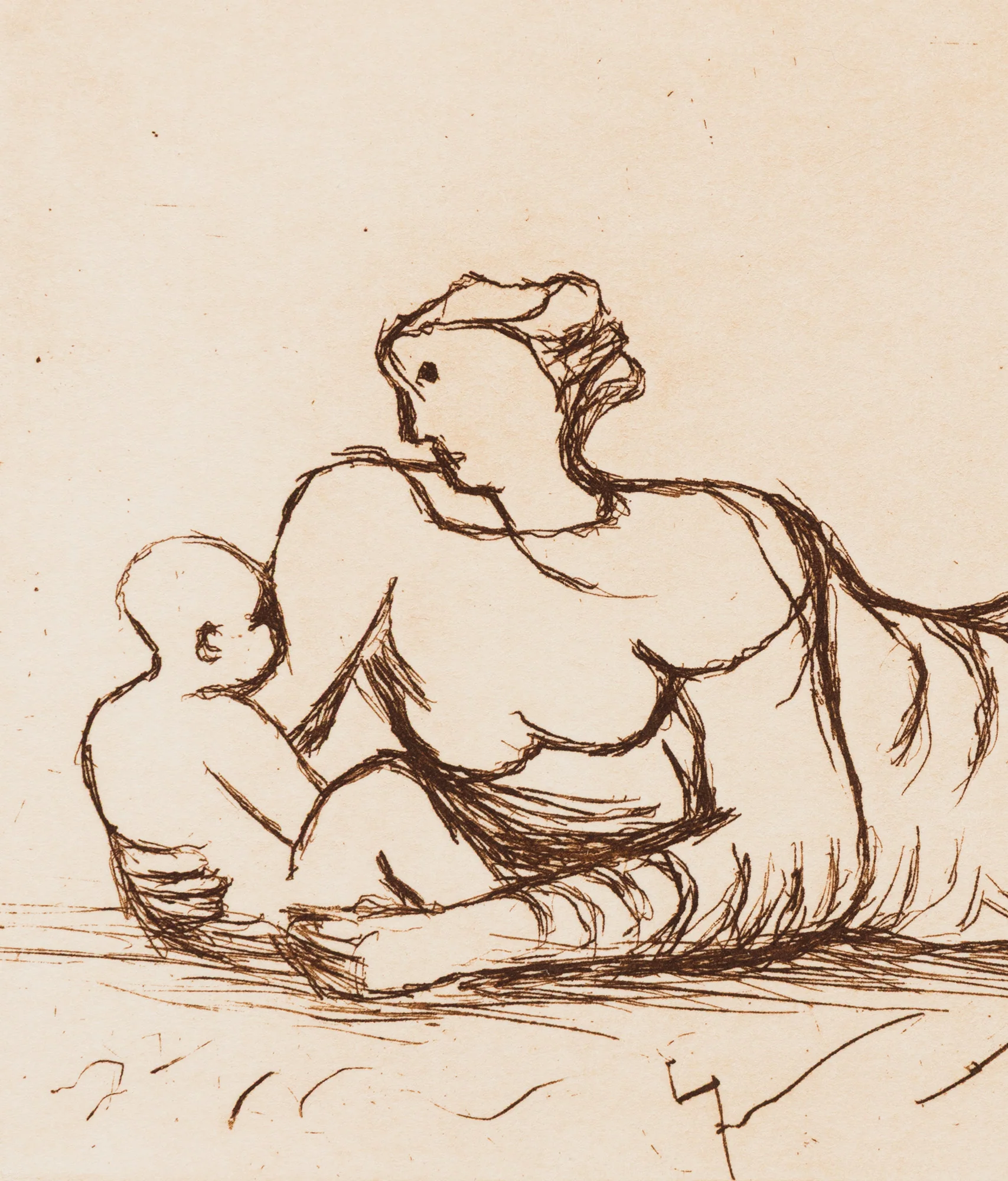
HENRY MOORE "MOTHER AND CHILD - PL 6" ETCHING, 1983
Henry Moore (1898-1986) is one of the most important Modernist sculptors. His large-scale semi-abstract sculptures can be seen not only in institutions around the world, but in many outdoor/public spaces as well.
Moore's aesthetic, whether expressed on paper or in three-dimensions, is simultaneously elegant yet slightly primitive. Moore's creations suggest they have been either reduced by time or the forces of nature but also demonstrate the artist's mastery at the stylization of the human body.
Caviar20 has a particular interest in sculptors who included printmaking as part of their process (Jean Arp, Louise Bourgeois, Kosso Eloul etc.). Henry Moore is one of the leading 20th century sculptors/printmakers.
During his lifetime, Moore created over 700 etchings, lithographs, etc., exploring all aspects of printmaking. The practice of printmaking was completely correspondent to his sculptures. He would explore the form or character in one medium and either later realize it in the other medium or vice versa. To learn more about Henry Moore's prints we recommend this video tour of an exhibition of Henry Moore's prints that was organized by the British Council.
This etching is one of eight from Moore's Mother and Child portfolio. A mother lays on the floor, holding a seated child in her outstretched arms. She gazes at her offspring, frozen in this precious moment. The figures are portrayed in Moore's sculptural style, their length and fullness coming through their two-dimensional portrayal.
On the title page of the portfolio, Moore includes a short descriptive text to describe his thoughts and reasoning behind the titular archetype:
The Mother and Child idea is one of my two or three obsessions. The subject itself is eternal and unending, a small form in relation to a big form, the big form protecting the small one and so on. It is such a rich subject, both humanly and compositionally, that I will always go on using it.
For art lovers in Toronto, Henry Moore has a special relevancy and connection. The Art Gallery of Ontario has the world's largest collection of Moore's work, including over 900 works, mostly donated by the artist in the early 1970's. Furthermore, Toronto has two major public Moore sculptures "The Archer" (in front of City Hall), and "Large Two Forms" (in Grange Park, behind the AGO).
Questions about this piece? Contact us, call +1.416.704.1720, or visit our Toronto gallery.
Plate Six, from Mother and Child
Signed, inscribed "PL 6," and numbered "50/50" in pencil, lower edge of plate
Signed in plate, lower right
Etching in sepia on Arches wove paper, 1983
Embossed with printers blindstamp
From an edition of 50 (+ 15 AP, 10 HC)
Printed by James Collyer and James Crossley, London
Published by Raymond Spencer Company Ltd., for the Henry Moore Foundation, Much Hadham, 1987
4"H 5"W (plate)
15"H 12.75"W (sheet)
17.5"H 15.5"W (framed)
Very good condition
Literature: Cramer 706
Reference: CGM 706
Henry Moore (1898-1986) is one of the most important Modernist sculptors. His large-scale semi-abstract sculptures can be seen not only in institutions around the world, but in many outdoor/public spaces as well.
Moore's aesthetic, whether expressed on paper or in three-dimensions, is simultaneously elegant yet slightly primitive. Moore's creations suggest they have been either reduced by time or the forces of nature but also demonstrate the artist's mastery at the stylization of the human body.
Caviar20 has a particular interest in sculptors who included printmaking as part of their process (Jean Arp, Louise Bourgeois, Kosso Eloul etc.). Henry Moore is one of the leading 20th century sculptors/printmakers.
During his lifetime, Moore created over 700 etchings, lithographs, etc., exploring all aspects of printmaking. The practice of printmaking was completely correspondent to his sculptures. He would explore the form or character in one medium and either later realize it in the other medium or vice versa. To learn more about Henry Moore's prints we recommend this video tour of an exhibition of Henry Moore's prints that was organized by the British Council.
This etching is one of eight from Moore's Mother and Child portfolio. A mother lays on the floor, holding a seated child in her outstretched arms. She gazes at her offspring, frozen in this precious moment. The figures are portrayed in Moore's sculptural style, their length and fullness coming through their two-dimensional portrayal.
On the title page of the portfolio, Moore includes a short descriptive text to describe his thoughts and reasoning behind the titular archetype:
The Mother and Child idea is one of my two or three obsessions. The subject itself is eternal and unending, a small form in relation to a big form, the big form protecting the small one and so on. It is such a rich subject, both humanly and compositionally, that I will always go on using it.
For art lovers in Toronto, Henry Moore has a special relevancy and connection. The Art Gallery of Ontario has the world's largest collection of Moore's work, including over 900 works, mostly donated by the artist in the early 1970's. Furthermore, Toronto has two major public Moore sculptures "The Archer" (in front of City Hall), and "Large Two Forms" (in Grange Park, behind the AGO).
Questions about this piece? Contact us, call +1.416.704.1720, or visit our Toronto gallery.
Plate Six, from Mother and Child
Signed, inscribed "PL 6," and numbered "50/50" in pencil, lower edge of plate
Signed in plate, lower right
Etching in sepia on Arches wove paper, 1983
Embossed with printers blindstamp
From an edition of 50 (+ 15 AP, 10 HC)
Printed by James Collyer and James Crossley, London
Published by Raymond Spencer Company Ltd., for the Henry Moore Foundation, Much Hadham, 1987
4"H 5"W (plate)
15"H 12.75"W (sheet)
17.5"H 15.5"W (framed)
Very good condition
Literature: Cramer 706
Reference: CGM 706
Description
Henry Moore (1898-1986) is one of the most important Modernist sculptors. His large-scale semi-abstract sculptures can be seen not only in institutions around the world, but in many outdoor/public spaces as well.
Moore's aesthetic, whether expressed on paper or in three-dimensions, is simultaneously elegant yet slightly primitive. Moore's creations suggest they have been either reduced by time or the forces of nature but also demonstrate the artist's mastery at the stylization of the human body.
Caviar20 has a particular interest in sculptors who included printmaking as part of their process (Jean Arp, Louise Bourgeois, Kosso Eloul etc.). Henry Moore is one of the leading 20th century sculptors/printmakers.
During his lifetime, Moore created over 700 etchings, lithographs, etc., exploring all aspects of printmaking. The practice of printmaking was completely correspondent to his sculptures. He would explore the form or character in one medium and either later realize it in the other medium or vice versa. To learn more about Henry Moore's prints we recommend this video tour of an exhibition of Henry Moore's prints that was organized by the British Council.
This etching is one of eight from Moore's Mother and Child portfolio. A mother lays on the floor, holding a seated child in her outstretched arms. She gazes at her offspring, frozen in this precious moment. The figures are portrayed in Moore's sculptural style, their length and fullness coming through their two-dimensional portrayal.
On the title page of the portfolio, Moore includes a short descriptive text to describe his thoughts and reasoning behind the titular archetype:
The Mother and Child idea is one of my two or three obsessions. The subject itself is eternal and unending, a small form in relation to a big form, the big form protecting the small one and so on. It is such a rich subject, both humanly and compositionally, that I will always go on using it.
For art lovers in Toronto, Henry Moore has a special relevancy and connection. The Art Gallery of Ontario has the world's largest collection of Moore's work, including over 900 works, mostly donated by the artist in the early 1970's. Furthermore, Toronto has two major public Moore sculptures "The Archer" (in front of City Hall), and "Large Two Forms" (in Grange Park, behind the AGO).
Questions about this piece? Contact us, call +1.416.704.1720, or visit our Toronto gallery.
Plate Six, from Mother and Child
Signed, inscribed "PL 6," and numbered "50/50" in pencil, lower edge of plate
Signed in plate, lower right
Etching in sepia on Arches wove paper, 1983
Embossed with printers blindstamp
From an edition of 50 (+ 15 AP, 10 HC)
Printed by James Collyer and James Crossley, London
Published by Raymond Spencer Company Ltd., for the Henry Moore Foundation, Much Hadham, 1987
4"H 5"W (plate)
15"H 12.75"W (sheet)
17.5"H 15.5"W (framed)
Very good condition
Literature: Cramer 706
Reference: CGM 706