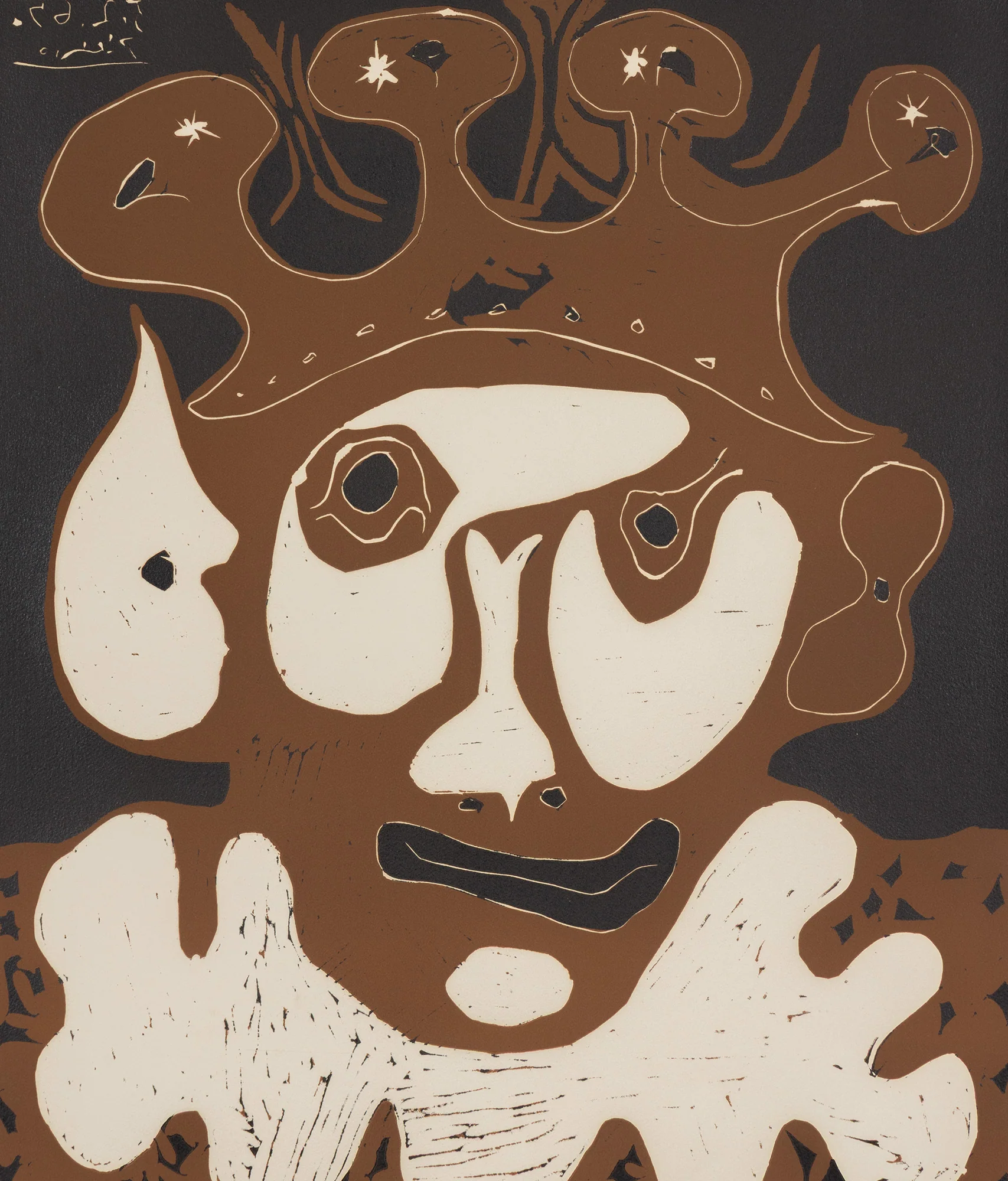
PABLO PICASSO "CARNAVAL" LINOCUT, 1965
Pablo Picasso (1881–1973) was one of the most transformative figures of 20th-century art. A restless innovator, his work reshaped the possibilities of representation across painting, sculpture, printmaking, and ceramics.
Moving both fluidly and abruptly between styles, Picasso approached art-making as a continual process of reinvention, combining tradition and experimentation into a single, urgent language. Within his vast and mutable practice, motifs such as the clown, the king, the harlequin, the matador and the buffoon recur as potent symbols of performance, vulnerability, and the shifting masks of (masculine) identity.
Tête de Bouffon is at once playful and unsettled, an ambiguous portrait of the jester that evokes paradoxes of performance: the laughter that hides sadness, the mask that conceals the self, and the role that becomes identity. As the figure oscillates between mockery and melancholy, he is not just a performer, but a symbol of human contradiction and complexity.
The figure's expression is highly ambiguous: the eyes, rendered with simple oval shapes, seem to peer out unevenly; a droplet-like form on one cheek could be a tear or a stylized flourish. The exaggerated crown flares into curling, organic shapes that suggest both festivity and distortion.
Created in 1965, "Tête de Bouffon" belongs to Picasso’s prolific late period, a time marked by an outpouring of prints in which he revisited lifelong motifs with a looser, more distilled graphic language. In these years, he returned repeatedly to the commedia dell’arte figures of his earlier decades, reworking them with renewed immediacy and humor.
The print reflects Picasso's late-style synthesis: A compression of decades of experimentation into bold contours, simplified forms, and an almost improvisational energy.
Questions about this piece? Contact us, call +1.416.704.1720, or visit our Toronto gallery.
"Carnaval"
France, 1965
Linocut in colors on Arches paper
Signed "Picasso" and numbered in pencil along lower edge
From an edition of 160
Published by Le Patriote, Nice, France
Printed by Imprimerie Arnéra, Vallauris, France
29.5"H 24.25"W (sheet)
43.5"H 38.5"W (framed)
Very good condition
Literature: BLOCH 1193; BAER 1356
Pablo Picasso (1881–1973) was one of the most transformative figures of 20th-century art. A restless innovator, his work reshaped the possibilities of representation across painting, sculpture, printmaking, and ceramics.
Moving both fluidly and abruptly between styles, Picasso approached art-making as a continual process of reinvention, combining tradition and experimentation into a single, urgent language. Within his vast and mutable practice, motifs such as the clown, the king, the harlequin, the matador and the buffoon recur as potent symbols of performance, vulnerability, and the shifting masks of (masculine) identity.
Tête de Bouffon is at once playful and unsettled, an ambiguous portrait of the jester that evokes paradoxes of performance: the laughter that hides sadness, the mask that conceals the self, and the role that becomes identity. As the figure oscillates between mockery and melancholy, he is not just a performer, but a symbol of human contradiction and complexity.
The figure's expression is highly ambiguous: the eyes, rendered with simple oval shapes, seem to peer out unevenly; a droplet-like form on one cheek could be a tear or a stylized flourish. The exaggerated crown flares into curling, organic shapes that suggest both festivity and distortion.
Created in 1965, "Tête de Bouffon" belongs to Picasso’s prolific late period, a time marked by an outpouring of prints in which he revisited lifelong motifs with a looser, more distilled graphic language. In these years, he returned repeatedly to the commedia dell’arte figures of his earlier decades, reworking them with renewed immediacy and humor.
The print reflects Picasso's late-style synthesis: A compression of decades of experimentation into bold contours, simplified forms, and an almost improvisational energy.
Questions about this piece? Contact us, call +1.416.704.1720, or visit our Toronto gallery.
"Carnaval"
France, 1965
Linocut in colors on Arches paper
Signed "Picasso" and numbered in pencil along lower edge
From an edition of 160
Published by Le Patriote, Nice, France
Printed by Imprimerie Arnéra, Vallauris, France
29.5"H 24.25"W (sheet)
43.5"H 38.5"W (framed)
Very good condition
Literature: BLOCH 1193; BAER 1356
Description
Pablo Picasso (1881–1973) was one of the most transformative figures of 20th-century art. A restless innovator, his work reshaped the possibilities of representation across painting, sculpture, printmaking, and ceramics.
Moving both fluidly and abruptly between styles, Picasso approached art-making as a continual process of reinvention, combining tradition and experimentation into a single, urgent language. Within his vast and mutable practice, motifs such as the clown, the king, the harlequin, the matador and the buffoon recur as potent symbols of performance, vulnerability, and the shifting masks of (masculine) identity.
Tête de Bouffon is at once playful and unsettled, an ambiguous portrait of the jester that evokes paradoxes of performance: the laughter that hides sadness, the mask that conceals the self, and the role that becomes identity. As the figure oscillates between mockery and melancholy, he is not just a performer, but a symbol of human contradiction and complexity.
The figure's expression is highly ambiguous: the eyes, rendered with simple oval shapes, seem to peer out unevenly; a droplet-like form on one cheek could be a tear or a stylized flourish. The exaggerated crown flares into curling, organic shapes that suggest both festivity and distortion.
Created in 1965, "Tête de Bouffon" belongs to Picasso’s prolific late period, a time marked by an outpouring of prints in which he revisited lifelong motifs with a looser, more distilled graphic language. In these years, he returned repeatedly to the commedia dell’arte figures of his earlier decades, reworking them with renewed immediacy and humor.
The print reflects Picasso's late-style synthesis: A compression of decades of experimentation into bold contours, simplified forms, and an almost improvisational energy.
Questions about this piece? Contact us, call +1.416.704.1720, or visit our Toronto gallery.
"Carnaval"
France, 1965
Linocut in colors on Arches paper
Signed "Picasso" and numbered in pencil along lower edge
From an edition of 160
Published by Le Patriote, Nice, France
Printed by Imprimerie Arnéra, Vallauris, France
29.5"H 24.25"W (sheet)
43.5"H 38.5"W (framed)
Very good condition
Literature: BLOCH 1193; BAER 1356