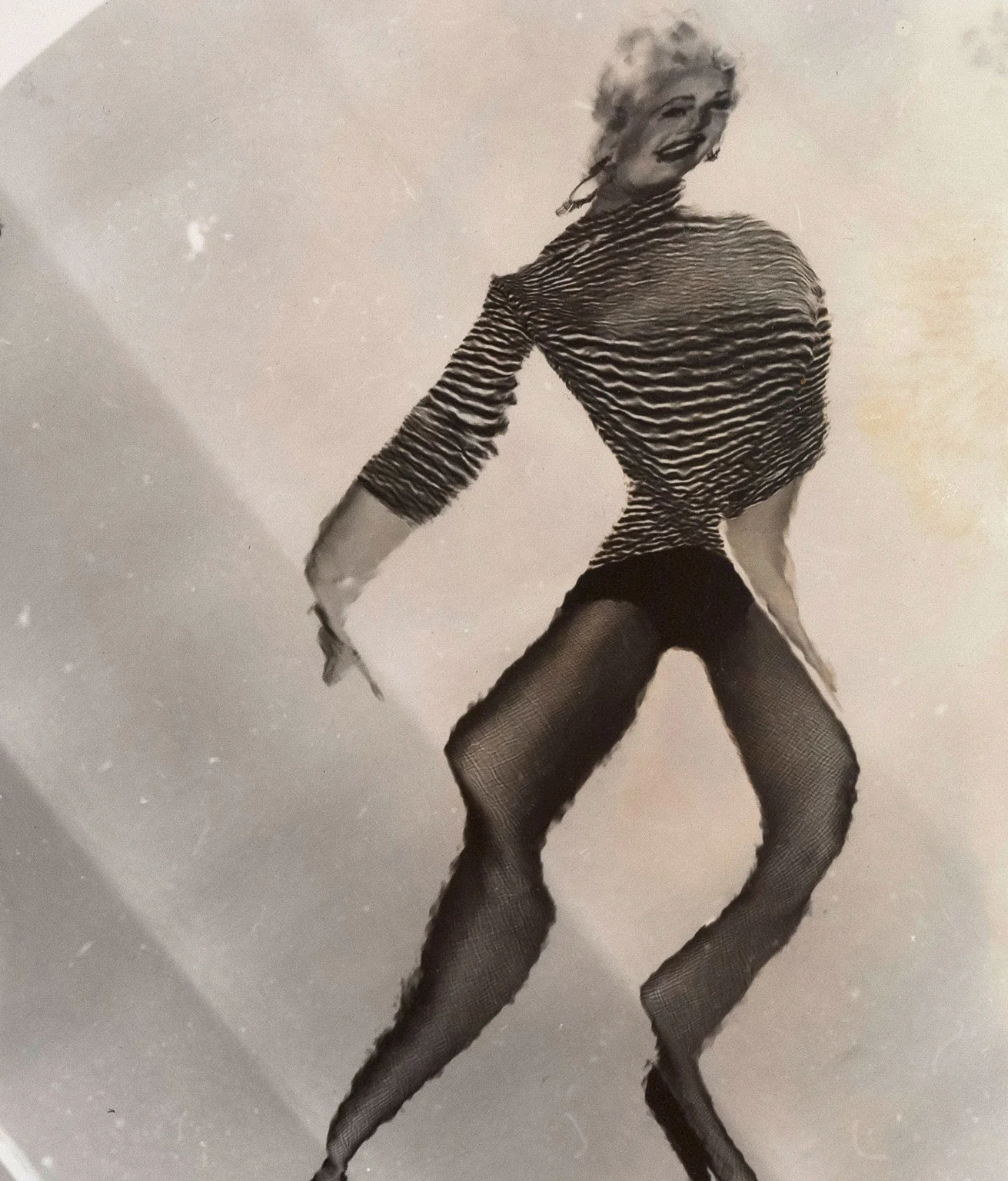
WEEGEE "JAYNE MANSFIELD DISTORTION", c. 1960
Arthur Felling, better known as Weegee (1899-1968) was a highly-successful (and notorious) photojournalist/artist. In addition to contributing an enormous number of images to various American newspapers, he would become famous, beyond New York and news circles, after the publication of Naked City (1945) and Weegee's People (1946).
Weegee's images of New York City crime, mishaps and tragedy are iconic and influential. Less well-known, however, is the work he focused on during the last twenty years of his life: known as the 'distortions' period. In the late 1940s, Weegee began experimenting with photographic manipulation both in the darkroom and using an array of filters or prisms (kaleidoscope) that created caricatured and distorted images.
Weegee created distortions of a wide range of subjects; celebrities, architecture, circus life, and nudes. "Jayne Mansfield Distortion" is a superb example of one of Weegee's images from this era.
Weegee's satirical images of celebrity pre-date Warhol's silkscreens by almost a decade. Similarly, many of the themes Weegee was exploring in these distortions, such as the cult of the artist, the cost of fame and the power/ubiquity of film stars, were expanded upon by Warhol in the 1960's. The artists knew each other and Weegee actually photographed Warhol on several occasions both straight on and as a distortion.
Weegee’s photography can be found in scores of museums and private collections worldwide: the J. Paul Getty Museum, Los Angeles; Museum of Modern Art, New York; San Francisco Museum of Modern Art; Museum of Modern Art, Oxford; Museum of Contemporary Art, Los Angeles; International Center of Photography, New York and more.
Questions about this piece? Contact us or call +1.416.704.1720
USA, circa 1960
Gelatin silver print
8.5"H 6.5"W (work)
15.75"H 12.5"W (framed)
"Weegee From Photo Representative" stamp (verso).
Condition: age toning and light stain right edge
Arthur Felling, better known as Weegee (1899-1968) was a highly-successful (and notorious) photojournalist/artist. In addition to contributing an enormous number of images to various American newspapers, he would become famous, beyond New York and news circles, after the publication of Naked City (1945) and Weegee's People (1946).
Weegee's images of New York City crime, mishaps and tragedy are iconic and influential. Less well-known, however, is the work he focused on during the last twenty years of his life: known as the 'distortions' period. In the late 1940s, Weegee began experimenting with photographic manipulation both in the darkroom and using an array of filters or prisms (kaleidoscope) that created caricatured and distorted images.
Weegee created distortions of a wide range of subjects; celebrities, architecture, circus life, and nudes. "Jayne Mansfield Distortion" is a superb example of one of Weegee's images from this era.
Weegee's satirical images of celebrity pre-date Warhol's silkscreens by almost a decade. Similarly, many of the themes Weegee was exploring in these distortions, such as the cult of the artist, the cost of fame and the power/ubiquity of film stars, were expanded upon by Warhol in the 1960's. The artists knew each other and Weegee actually photographed Warhol on several occasions both straight on and as a distortion.
Weegee’s photography can be found in scores of museums and private collections worldwide: the J. Paul Getty Museum, Los Angeles; Museum of Modern Art, New York; San Francisco Museum of Modern Art; Museum of Modern Art, Oxford; Museum of Contemporary Art, Los Angeles; International Center of Photography, New York and more.
Questions about this piece? Contact us or call +1.416.704.1720
USA, circa 1960
Gelatin silver print
8.5"H 6.5"W (work)
15.75"H 12.5"W (framed)
"Weegee From Photo Representative" stamp (verso).
Condition: age toning and light stain right edge
Original: $3,500.00
-70%$3,500.00
$1,050.00Description
Arthur Felling, better known as Weegee (1899-1968) was a highly-successful (and notorious) photojournalist/artist. In addition to contributing an enormous number of images to various American newspapers, he would become famous, beyond New York and news circles, after the publication of Naked City (1945) and Weegee's People (1946).
Weegee's images of New York City crime, mishaps and tragedy are iconic and influential. Less well-known, however, is the work he focused on during the last twenty years of his life: known as the 'distortions' period. In the late 1940s, Weegee began experimenting with photographic manipulation both in the darkroom and using an array of filters or prisms (kaleidoscope) that created caricatured and distorted images.
Weegee created distortions of a wide range of subjects; celebrities, architecture, circus life, and nudes. "Jayne Mansfield Distortion" is a superb example of one of Weegee's images from this era.
Weegee's satirical images of celebrity pre-date Warhol's silkscreens by almost a decade. Similarly, many of the themes Weegee was exploring in these distortions, such as the cult of the artist, the cost of fame and the power/ubiquity of film stars, were expanded upon by Warhol in the 1960's. The artists knew each other and Weegee actually photographed Warhol on several occasions both straight on and as a distortion.
Weegee’s photography can be found in scores of museums and private collections worldwide: the J. Paul Getty Museum, Los Angeles; Museum of Modern Art, New York; San Francisco Museum of Modern Art; Museum of Modern Art, Oxford; Museum of Contemporary Art, Los Angeles; International Center of Photography, New York and more.
Questions about this piece? Contact us or call +1.416.704.1720
USA, circa 1960
Gelatin silver print
8.5"H 6.5"W (work)
15.75"H 12.5"W (framed)
"Weegee From Photo Representative" stamp (verso).
Condition: age toning and light stain right edge